
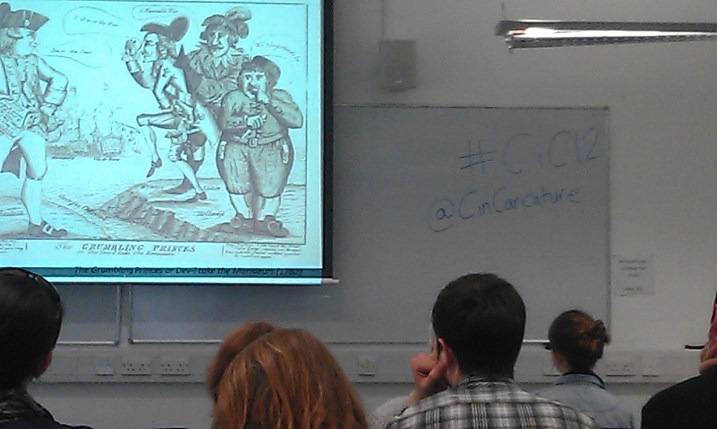
Cradled in Caricature, an exploration of caricature as a social and artistic device, took place at the University of Kent, Canterbury, on Friday (April 27th).
The day was broken into five sessions. After a some short framing remarks from me, three research students (from University College London, the Barber Institute of Fine Arts, and the University of Kent respectively) presented papers on caricature in the eighteenth-, nineteenth-, and twentieth- centuries, covering British, French, and Chilean design.

Next up were our two invited speakers, Richard Taws and Ernesto Priego, who offered two very different papers – the first a tight discussion of the meaning of violence in the work of Etienne Bericourt, the second a digital humanities reading of the British Cartoon Archive.
Following a discussion of the nature and meaning of the archive we took lunch, and returned to a panel proposed by two doctoral students and one early-career researcher affiliated with the Centre for Eighteenth Century Studies at the University of York. There were plenty of bums and plenty of excrement, but also plenty of insights on identity in Georgian satire and travel literature.
We then moved swiftly onto our keynote. Robert Patten from Rice University dramatically read and reread the meaning of Paul Pry, the umbrella-wielding fictional celebrity of London’s theatres between 1825-6. Patten promised a presentation unfit for the under-18s and over-60s, and he delivered, with a paper packed full of musty melon gags, visual vaginal allusions, and erotically charged postures.
The day ended with a workshop on stand-up comedy led by Oliver Double, Head of Drama at the University of Kent. In pairs and small groups we pulled daft faces, made silly sounds, acted out absurd characters, and told anecdotes. But above all we laughed. This was followed by a discussion of theatricality and performativity, and how these aspects of human experience could be better integrated into our work, before we retired to enjoy wine, dinner, and conversation.
Live audio from the event was broadcast live online (with presentations uploaded so visuals could be followed), and across the day we received a number of questions and comments from online participants. Productive online backchatter was also enjoyed by a number of participants using the #CiC12 hashtag (and a Storify of our discussions can be found here).
All the sessions, presentations, and questions are available for download here.
I would like to thank all those who helped make the day a success, with particular thanks going to Danielle Thom, Emily Dennis, and Tim Keward. I would also like to thank all the speakers and participants for their engaging and insightful papers, and all delegates for their enthusiasm and inquisitive natures.
Now #CiC12 is over the spectre of #CiC13 looms on the horizon. What themes do you want to explore? What media do you want to interrogate under the auspices of caricature? Perhaps #CiC13 could move towards ‘Cradled in Comics’? Any ideas, thoughts, or suggestions please get in touch at cradledincaricature@gmail.com.
This event was supported by the Faculty of Humanities, University of Kent, the Department of History of Art, University College London, The Paul Mellon Centre for Studies in British Art, and the Graduate School, University of Kent.





You must be logged in to post a comment.