CRADLED IN CARICATURE : a multidisciplinary event
Friday 27 April 2012, COLT3, University of Kent, Canterbury
Paul Mellon travel bursaries
The Cradled in Caricature organising committee are delighted to announce that travel bursaries have been awarded to four early career scholars attending #CiC12. These bursaries are generously funded by The Paul Mellon Centre for Studies in British Art.
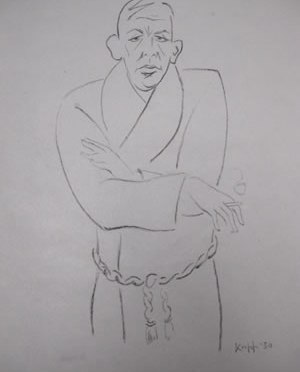
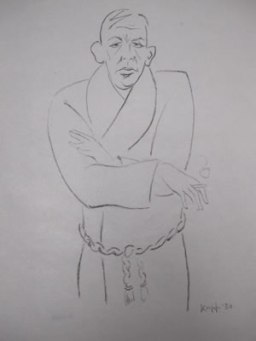
- Emalee Beddoes from the University of Birmingham has been awarded a travel bursary for her proposal ‘Imaging the Inside: Edmond Xavier Kapp, psychological portraiture and the assumption of the creative “type”‘. This paper promises to discuss “the works of the now little known caricature artist, Edmond Xavier Kapp, whose work depicts some of the greatest figures of the twentieth century: from Winston Churchill to Percy Wyndham Lewis and Albert Einstein. It will explore the overlap between caricature and psychological portraiture and discuss how both of these genres assume the possibility of a physical embodiment of personality, and how both facilitate the stereotype of the creative genius who possesses superior insight into the interior life of individuals.”

- Amy Milka, Graeme Callister, and John Richard Moores from The Centre for Eighteenth Century Studies at the University of York have been jointly awarded a travel bursary for their panel proposal ‘Cradled in Contrast: The application of national stereotypes in eighteenth century caricature‘. This panel will tease at the intersections between English comic art, nationalism, stereotyping, and travel literature.
The Cradled in Caricature organising committee are delighted to support the attendance of Emalee, Amy, Graeme, and John at #CiC12. We thank The Paul Mellon Centre for Studies in British Art once more for making this possible by awarding Cradled in Caricature an Educational Programme Grant.
**********
Attendance at Cradled in Caricature is free of charge though places are limited. To book a place at this event please email cradledincaricature@gmail.com.
For further announcements, please follow us on Twitter @CinCaricature and #CiC12
Cradled in Caricature is supported by the Faculty of Humanities, University of Kent, the Department of History of Art, University College London, The Paul Mellon Centre for Studies in British Art, and the Graduate School, University of Kent.




You must be logged in to post a comment.