Every good novel contains an unforgettable statement. What this may be is of course highly personal, often dictated by a mood or an event experienced by the reader outside of the narrative arc. Towards the conclusion of 1Q84 a simple, unforgettable thought slips from Tamaru: “Everyone’s death should be mourned. Even if just for a short time”.
This line stuck with me for a particular, personal reason. For coming to the end of every Murakami novel provokes the same emotional response. What will I do when there are no more new Murakami novels to read? There will be no more dinners between a truck-driver and a man who can communicate with cats. No more laboratories hidden in archaic sewer systems. No more men peeled alive like ripe fruit. No more smokey jazz bars. No more androgynous librarians.
The possibility of the death of Murakami is something that has genuinely troubled me. Yet Tamaru’s thoughts, delivered as he is leaving a cold, sparse apartment building, allowed for a moments pause. All death should be mourned. Not merely that which is a loss to you personally.
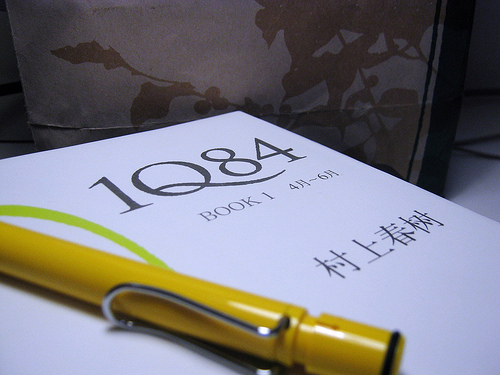
In the spirit of the ‘review’ aspect of this unreview, I probably should talk briefly about the novel itself. Some stodgy elements of Book 3 aside I found 1Q84 breathtaking, and the thunderstorm section in particular one of Murakami’s most evocative, shocking, and beautiful pieces of writing. There will be no synopsis here. Nor spoilers. Just some thoughts that occurred to me.
Pointed things can be creepy 1Q84 contains a small ice-pick used to deliver nastiness to a certain part of the body. On every occasion it came up I felt physically uncomfortable and compelled to scratch that part of my body. Shiver.
Murakami still can’t do sex His sex scenes have always been a little on the odd side. Here they reach new crescendos of cringe. Forgive the pun.
Boring is atmospheric Every garment, every haircut, every soft furnishing, and the preparation of every dinner is described in intimate detail. Unlike a formulaic murder mystery there is no narrative purpose to this, no need to offer clues and red-herrings in a Poirot-esque fug of absurd cleverness. In 1Q84 they dress the narrative and remind the reader that the essence of life is in the minutiae of life. The crease of a jacket. The colour of a stem of broccoli. The heat and smell of a handrail.
Book 3 takes this premise to absurd lengths, teasing the reader with narrative repetition, a glacial cat-and-mouse, and hours of waiting. For some this proved too much. Yet for me the frustration was atmospheric. One of the overarching lessons of Murakami’s work has been that life is unresolvable. Threads are never tied together. Most famously, if your best friend kills himself you will most likely never know why. 1Q84 foregrounds another mantra lingering in the recesses of his recent works. Life is slow. And that is okay.
Don’t break the spell Juggling multiple first-person narratives is hard. Even Murakami drops the ball with a poorly timed recap of where what is happening now fits with the timeline of what is happening in the other chapters. I suddenly heard the author rather than the characters. I briefly left 1Q84.
Cats This time a whole town of them.
Ushikawa The star of book three. A man so ugly and described so many times I actually have no idea what he looks like. I reckon if we pieced all the bits together he’d actually look relatively sharp. Perhaps.
Put a Tiger in Your Tank So many meanings I can barely begin to explain.
 cradledincaricature
You must be logged in to post a comment.