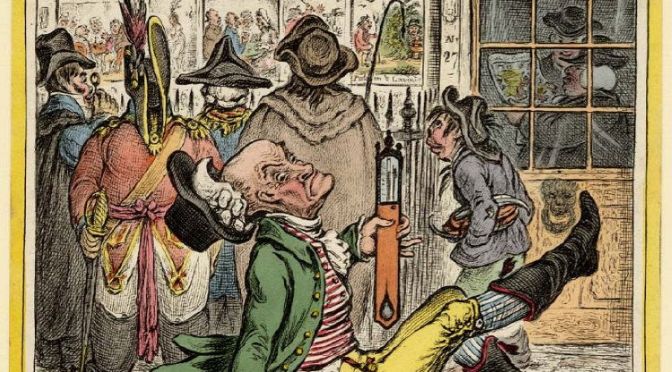
Adorning the cover of Diana Donald’s classic The Age of Caricature is a Gillray print with which scholars of Georgian culture are all too familiar – his VERY SLIPPY-WEATHER (Hannah Humphrey, 10 February 1808). In the foreground a grotesque cit slips while traversing an icy footpath, but the eye is drawn away from this calamity to the spectacular setting of the design – the print-shop window of Hannah Humphrey and the multi-class crowd who gather to admire it.

Historians have rightly displayed caution when using such scenes as windows (no pun intended) into Georgian social life. Satirical prints are, after all, representations of urban life rather than representative recordings of metropolitan scenes. The print-shop window has, however, tended to provoke something of a methodological amnesia in scholars. Hence Donald, like M. Dorothy George before her (in Hogarth to Cruikshank), tends to see such scenes as proof of the egalitarian nature, reach, and intention of satirical prints and the trade in graphic satire.
This, I argue, is false, and the print-shop window scenes such as these are red-herrings. My reasons are as follows:
- First. Prints representing print-shop windows published during the so-called ‘Golden Age’ of graphic satire (circa 1780-1810) are almost always produced by the publisher whose shop is depicted. Hence they, first and foremost, are puffs.
- Second. Satirical prints were luxury items, and hence the spectators depicted within such prints were for the most part not patrons of print-shops. This distinction is important. Print-shops were businesses, and although they undoubtedly benefited from the presence of crowds, the discourses within satirical prints were aimed not at a heterogeneous public but at their likely purchaser. Those who find this contention problematic need, I argue, to address more closely a simple question – why would these businesses aim their product at people outside of the likely purchasing community?
- Third. From around the 1820s numerous print-shop window scenes appear which are not depictions of the print-shops of their publishers. Indeed they begin to mock the crowds viewing prints in print-shop windows quite viciously. However historians rarely consider that these latter prints are commentaries. Placed within the physical confines of ‘march of mind’ publications, they may look similar to their print-shop window counterparts from the 1790s-1810s but they are in fact not only a different form but an entirely different medium. The two, therefore, must be disentangled.
- Fourth. Gillray’s VERY SLIPPY-WEATHER is brilliant. A classic example of Gillray’s ambiguous and loaded mode of communication. However rather than being an isolated print it is part of a series of designs exploring the contest between man and nature. This is usually given only a cursory mention by scholars, but surely it is the most important feature of the print over and above the framing device the design deploys?
Post-Donald the print-shop window has become a useful and largely unproblematised shorthand for the ‘popularity’ and ‘public’ reach of satirical prints in the late-Georgian period. This has, I argue, distracted us from the task of understanding the commercial, economic, material, and environmental realities within which these works were produced; from seeing that form and function shaped profoundly the process of constructing representations.
 cradledincaricature
You must be logged in to post a comment.