According to my colleague John Wills, the United States has spent much of the last 100 years ‘Inviting Doomsday’. In the much the same way as ‘detached’ networks such as Al Jazeera offered some of the most enlightening reflections on the August riots, British cartoonists provide valuable perspectives on this American folly.
Dave Brown is perhaps most known for his anti-American cartoons. These two below, on response of President Bush to Hurricane Katrina (and which form part of the Flirting with Apocalypse group on the British Cartoon Archive website), are perhaps his finest work.
 (c) Dave Brown, British Cartoon Archive, University of Kent, Dave Brown, The Independent, 3 September 2005.
In Après le Deluge…Moi Brown uses Millias’ Ophelia (1851-2) [Tate Britain N01506], a painting after Shakespeare’s Hamlet, to satirise Bush’s unawareness of danger. Bush, like Ophelia, drowns, yet unlike his Shakespearean counterpart the former is surrounded by floating detritus. This, like the cuts to Federal Flood defence and Army Engineer Corp budgets and his reluctance to bind the United States to the Kyoto climate change protocol, Bush both cannot see and does not want to see.
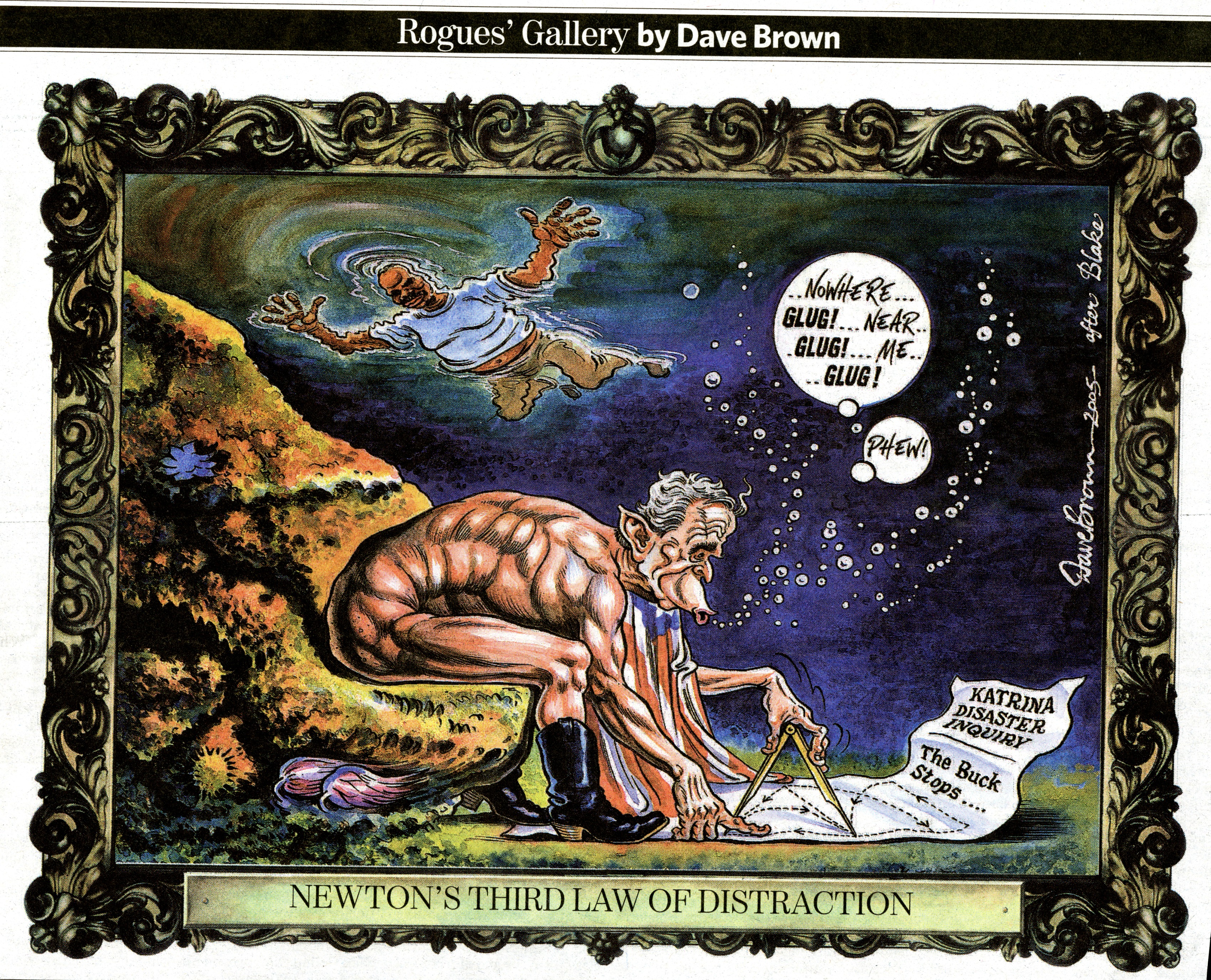 (c) Dave Brown, British Cartoon Archive, University of Kent, Dave Brown, The Independent, 10 September 2005.
In Newton’s Third Law of Distraction Brown this times takes his cues from William Blake, whose Newton (1795) rejected the single-mindedness of the Enlightenment philosopher. Bush is equally stubborn and inflexible with his calculations (and those, Brown accuses, of the United States administration he controls) concluding that the blame for Katrina stops ‘…NOWHERE…NEAR…ME…’. Linking Bush with a scientist such as Newton allows Brown to also deliver an environmental message – that Bush’s self-serving pseudo-science whilst the leader of the worlds most polluting nation has made him culpable for extreme weather events such as Katrina.
 cradledincaricature
You must be logged in to post a comment.