Some months ago I was commissioned by the British Cartoon Archive to produce two teaching aids using groups of cartoons from the archive’s online catalogue. This work coincided with the BCA’s JISC funded CARD project where 14,500 political cartoons from British national newspapers and magazines between 2003 and 2011 were digitised.
My task then was to craft two interpretive frameworks which would draw together cartoons from across the collection, showcase the recently digitised cartoons and the improved functionality of the website, and demonstrate how a century of cartooning can be approached and rationalised by scholars of British society and culture.
‘Memory and Remembrance’, my first collection, explores how British cartoonists have engaged with and reappropriated themes such as heroism, conflict, and loss. It also investigates how the symbols and signs conflict generates can be used to frame satire. For example, a section on ‘The Poppy’, includes the following interpretation of a Bill Caldwell design:
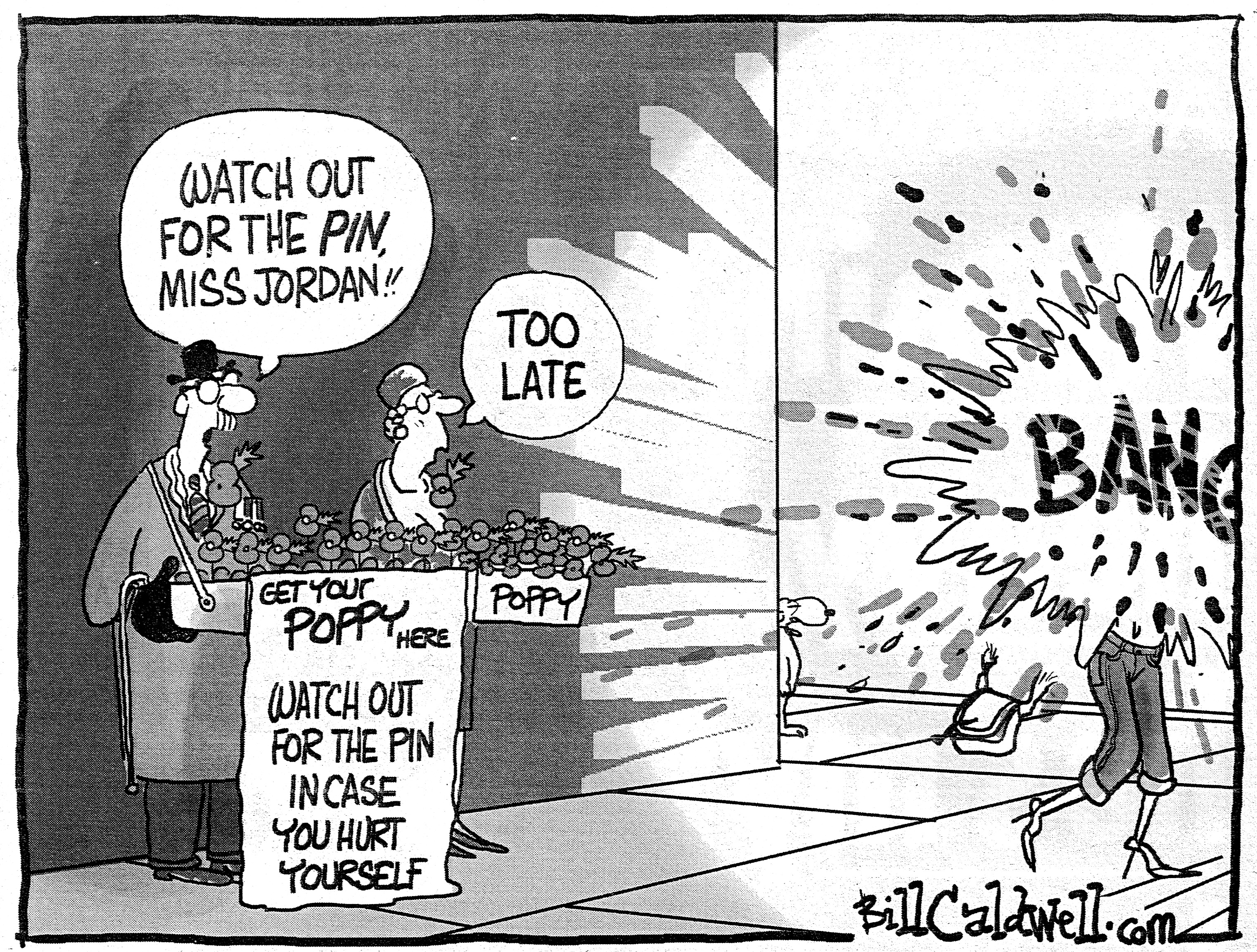
(c) Bill Caldwell, British Cartoon Archive, University of Kent, Bill Caldwell, The Sun, 03 Nov 2003.
Though retaining a clear connection to war and respect for the dead, buying a poppy is also a custom. Part of that custom involves the poppy seller – typically a veteran or widow of a veteran – selling poppies on the street to passers-by and offering them a pin with which to attach their mark of remembrance. When that custom is perceived to be subverted, as in the case of concerns over health and safety, responses tend to appropriate the custom itself rather than the function of that custom.
Here Caldwell takes a jovial look at typically misplaced reflections on ‘political correctness gone mad’. Over-analysis of the design could make the connection between grenades and remembrance poppies seem distasteful; yet, ultimately, it is little more than a joyously irreverent and superbly executed joke.
The second group, ‘Flirting with Apocalypse’, approaches British cartoons on environmental topics through the paradigm of recent scholarship which claims that the rhetoric of apocalypse has moved during the twentieth century from fears of sudden destruction to a gradual slide towards doomsday. Artists from W. K. Hazelden to Steve Bell are present, as is this design by Mel Calman:

(c) S & C Calman, British Cartoon Archive, University of Kent, Mel Calman, The Times, 08 Oct 1981.
In his distinctively minimalism style, Calman imagines oil seeping from the television the moment ‘THE NEWS’ flashes onto the screen. A glum disposition suggests this is not something to be celebrated. Events of the early 1980s highlighted the volatility of oil as both a commodity and a substance. After the events of 1973, the 1979 oil crisis bookended a decade of energy concerns, and by 1981 crude oil prices reached a peak of nearly 40 dollars per barrel (more than double what they were just two years previous). These crises, however, had compelled Europe and the United States to look outside of OPEC for oil imports. Norway, Mexico and Nigeria were courted by the free-market, leading ultimately to the oil glut of the 1980s.
In Nigeria, where drilling have began in 1958, Shell and BP used this opportunity to aggressively pursue fresh oil reserves. But poor operational standards brought with it increased spillages. Corrosion of pipes in particular has been blamed for approximately half of the nearly 1.8 million barrels of oil spilt between 1978 and 1981. Indeed in 1980 alone 241 near shore spills resulted in 600,000 barrels of oil polluting the Nigerian coastline, destroying people’s livelihoods and the environment they depend upon.
Science had therefore failed to solve the problem of oil, and Calman reflects that pessimism. Regrettably, the reckless behaviour of multinationals with respect to poor countries and their environments persists today.
Both groups utilise the group functionality bespoke to the BCA website, which allows users to collect together selections of cartoons and include alongside them personalised annotations and descriptions. Any registered user can construct their own groups, which are available publicly on the website and to download in .doc and (new for 2011) .ppt formats. It is hoped then that the flexibility of this resource will make it attractive to teachers both in schools and in HE.
So if this sounds of interest to your research/teaching please check it out. Registration is free, so please play, share, laugh, and create.
 cradledincaricature
You must be logged in to post a comment.