
With research and teaching plans tumbling around my head, I visited the Science Museum yesterday to pick through the Information Age Gallery in the company of Oliver Carpenter, Curator of Infrastructure and Built Environment, historian of technology, and good friend. As someone whose research lingers at length on how and by whom things are made, sold, and used, I’m keen to keep in mind that all this data floating around us – historic or otherwise – is connected to tangible, physical, grabbable things.
Things like corkboard server racks that Google cobbled together in 1998 to meet demand on their new search engine, an object that brings to mind the land once used for agriculture that now hosts server farms (say in Ireland by Microsoft to support their Azure cloud: diagram, deck) in order to meet our demand data everywhere, all of the time.
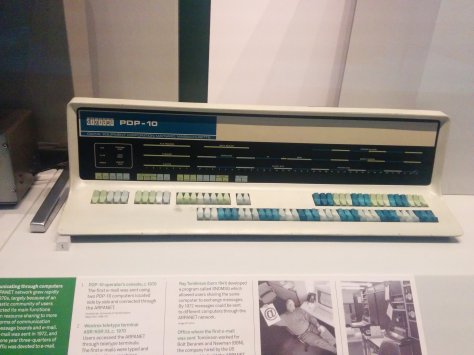
Things like a PDP-10 Operating Console used in the early 1970s to send messages (ergo emails) around the ARPANET (ergo – ish – the internet), an object that suggests that our interfaces with computers are not things that are given, not things that are just there, but methods of accessing data that exist in a complex interplay of choosing and being chosen.
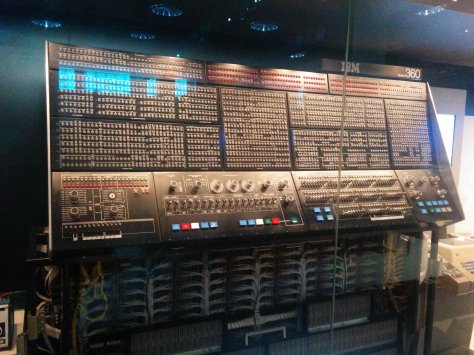
Things like the IBM System 360, one of the first computers that was networked, an object whose size, presentation, and computer-terminal-as-caricature-like appearance speak to how we perceive computation in media and film: as complex, opaque, blackboxed.
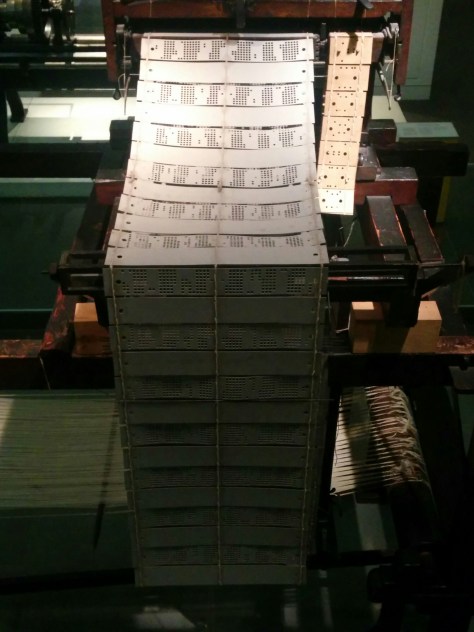
Things like (from a nearby gallery) the Jacquard Machine, an early-nineteenth century punch card driven system for weaving patterned fabrics, an object that refutes the elision of technology (and especially computational technology) with the now, the contemporary, the solutionist, self-aggrandising and innovation-laden language of Silicon Valley or Silicon Roundabout (on which I can’t recommend David Edgerton’s The Shock of the Old enough).
Things then that span a good two centuries of human history. Things that point to real changes in society and culture. And things without which our data lacks meaning and can too easily be decontextualised, can – as Nathan Jurgenson argues in an excellent essay in The New Inquiry – slide into supporting rationalist fantasies of big data as providing a disinterested picture of reality, of human phenomena: a narrative of objectivity, of having harnessed a view from nowhere, promulgated by a tech industry oblivious to and ignorant of the biases in their data capture, of the lived world their data inhabits.
Whether I am thinking about how ordinary people expressed themselves on Geocities and Amazon in the 1990s or about ripping apart, remixing, and recontextualising as data information on London businesses assembled for and printed in late-Georgian directories, the meanings and contexts these things have to offer strike me as vital.
 cradledincaricature
You must be logged in to post a comment.