As I study prints I am often asked whether I collect prints. The short answer is no. Though I do have an edition of The Tour of Doctor Syntax in Search of the Picturesque (1812) and some assorted comic annuals and issues (a New Yorker annual from the mid-20th century, a Heath Robinson collection, a Dandy issue from the year I was born), these do not a collection make.
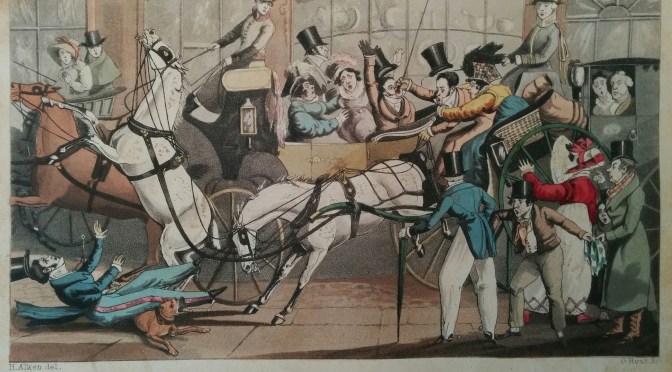
This weekend I purchased (for a remarkably modest sum) two prints: Tandem Driving and Wild Fowl Shooting. Both were designed by Henry Alken, engraved by G Hunt, thereafter hand-coloured by an anonymous colourist, and published in 1822 by Thomas McLean from his shop on the Haymarket. They are ‘sporting prints’, light comic scenes as much aimed at the market for cutting up into ‘scraps’ for collaging – a market for ‘relatively unambitious jokes’ that Brian Maidment brings to life in his excellent Comedy, Caricature and the Social Order 1820-1850 – as for framing and appreciating; a market McLean – though little is known of him – was at the forefront of.
The prints caught my eye for a couple of reasons.
First, they are nice examples of multi-modal satirical prints, by which I mean prints that were available for purchase individually or bound up in book form (in this case as part of McLean’s short-lived The Sporting Repository). These prints were flexible commercial objects and an important component of the experimentation that characterised English satirical prints circa 1820s-1830s, after the move away from the single-sheet satire that dominated the period between the late-1780s and early-1810s (see Maidment).
 Henry Alken, Tandem Driving (1822, Thomas McLean).
Second, Wild Fowl Shooting is terribly printed and – to compensate – heavily coloured. Graphic satires in this period were, as they had been since before Hogarth (1697-1764), printed from etched and engraved copper plates. The softness of copper made it ideal for etching and engraving. But that same softness meant that plates degraded during every pass through the printing press. As a consequence, prints made late into a print run (roughly 1000-1500 prints in) had etched and engraved areas that neither held ink nor transferred ink to paper as the artist-engraver intended. Due to the collecting biases of memory institutions (they tend to prefer good quality examples or take in collections from collectors who preferred good quality example), few poor quality prints exist in our major print collections (though there are some nice examples in the British Museum collection which you can consult side-by-side with the good quality ones). What fascinates me about these poor quality prints is that they had a market function, they were made and therefore they could be sold. With plates so sensitive to wear and raw materials such as paper so expensive all productions had to be squeezed for profit, meaning that the market was tiered not only between plates but also between impressions from a single plate. This inherent variability between impression caused by the properties of these raw materials (loaded onto which is the fact that plates were hand inked and hand pressed and impressions were hand coloured) serves to remind us that using ‘copies’ and ‘reproductions’ to describe these impressions is, without qualification, something of an anachronism.
 Henry Alken, Wild Fowl Shooting (1822, Thomas McLean)
During the process of cleaning them up and reframing them I took some photographs and, as both prints are out of copyright, I uploaded them to Wikimedia Commons. Wikimedia Commons holds an invaluable collection of images uploaded by individuals and memory institutions under open licences. I have designated these two public domain, meaning that not only can anyone can find and appreciate these images but they can use and reuse them at their leisure. Hurray for the Commons!
 cradledincaricature
You must be logged in to post a comment.