All posts by jwbaker

James Baker is Director of Digital Humanities at the University of Southampton. James is a Software Sustainability Institute Fellow, a Fellow of the Royal Historical Society, and holds degrees from the University of Southampton and latterly the University of Kent, where in 2010 he completed his doctoral research on the late-Georgian artist-engraver Isaac Cruikshank. James works at the intersection of history, cultural heritage, and digital technologies. He is currently working on a history of knowledge organisation in twentieth century Britain. In 2021, I begin a major new Arts and Humanities Research Council funded project 'Beyond Notability: Re-evaluating Women’s Work in Archaeology, History and Heritage, 1870 – 1950'. Previous externally funded research projects have focused on legacy descriptions of art objects ('Legacies of Catalogue Descriptions and Curatorial Voice: Opportunities for Digital Scholarship', Arts and Humanities Research Council), the preservation of intangible cultural heritage ('Coptic Culture Conservation Collective', British Council, and 'Heritage Repertoires for inclusive and sustainable development', British Academy), the born digital archival record ('Digital Forensics in the Historical Humanities', European Commission), and decolonial futures for museum collections ('Making African Connections: Decolonial Futures for Colonial Collections', Arts and Humanities Research Council). Prior to joining Southampton, James held positions of Senior Lecturer in Digital History and Archives at the University of Sussex and Director of the Sussex Humanities Lab, Digital Curator at the British Library, and Postdoctoral Fellow with the Paul Mellon Centre for Studies in British Art. He is a member of the Arts and Humanities Research Council Peer Review College, a convenor of the Institute of Historical Research Digital History seminar, a member of The Programming Historian Editorial Board and a Director of ProgHist Ltd (Company Number 12192946), and an International Advisory Board Member of British Art Studies.

Week 25: The Royal Brat

Picking your teeth with a fork is always a sign of class.

This Thursday I am heading to Hanover for the Herrenhäusen Symposium “Loyal Subversion – Caricatures from the Personal Union between England and Hanover 1714-1837”. Speakers include Timothy Clayton, Ian Haywood, Brian Maidment and Sheila O’Connell. The programme for the three days can be found here.

Aside from visiting Hanover for the first time, I’m thoroughly looking forward to speaking alongside scholars whose work has shaped our understanding of the Georgian satirical print. My contribution, a paper entitled ‘The Royal Brat: Making Fun of George Augustus Frederick‘, explores a selection of satirical prints which looked unfavourably upon the notorious behaviour of the Prince of Wales during the 1790s. The twist is that I do so through the lens of how these satirical prints were made, how the processes of making and selling shaped and constrained the comic content that Georgian Londoners could buy: particularly those who frequented Samuel Fores’ shop on Piccadilly. The point is that satirical prints were time-consuming and costly to make, with a limited window for both sale and exploitation: for example the copper plates on which designs were engraved and/or etched were limited to circa 500 impressions. To maximise profits then, those who published and sold satirical prints had to judge carefully – as one would expect of any good businessman or woman – what the market wanted, and in doing so would hedge often their bets: preferring prints which titillated without alienating, attacked without appearing crude, censored without coming across as righteous. One false move and a print publisher could alienate a range of both existing and potential customers. Making fun of George Augustus Frederick [get it?] was a delicate business.
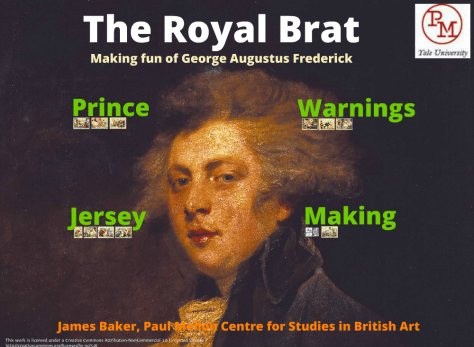
Click the picture to view the Prezi.

The third Herrenhausen Symposium “Loyal Subversion – Caricatures from the Personal Union between England and Hanover 1714-1837” is organized by the Volkswagen Foundation and the Wilhelm Busch – Deutsches Museum für Karikatur und Zeichenkunst. It runs from Thursday 21 February to Saturday 23 February 2013.