All posts by jwbaker

James Baker is Director of Digital Humanities at the University of Southampton. James is a Software Sustainability Institute Fellow, a Fellow of the Royal Historical Society, and holds degrees from the University of Southampton and latterly the University of Kent, where in 2010 he completed his doctoral research on the late-Georgian artist-engraver Isaac Cruikshank. James works at the intersection of history, cultural heritage, and digital technologies. He is currently working on a history of knowledge organisation in twentieth century Britain. In 2021, I begin a major new Arts and Humanities Research Council funded project 'Beyond Notability: Re-evaluating Women’s Work in Archaeology, History and Heritage, 1870 – 1950'. Previous externally funded research projects have focused on legacy descriptions of art objects ('Legacies of Catalogue Descriptions and Curatorial Voice: Opportunities for Digital Scholarship', Arts and Humanities Research Council), the preservation of intangible cultural heritage ('Coptic Culture Conservation Collective', British Council, and 'Heritage Repertoires for inclusive and sustainable development', British Academy), the born digital archival record ('Digital Forensics in the Historical Humanities', European Commission), and decolonial futures for museum collections ('Making African Connections: Decolonial Futures for Colonial Collections', Arts and Humanities Research Council). Prior to joining Southampton, James held positions of Senior Lecturer in Digital History and Archives at the University of Sussex and Director of the Sussex Humanities Lab, Digital Curator at the British Library, and Postdoctoral Fellow with the Paul Mellon Centre for Studies in British Art. He is a member of the Arts and Humanities Research Council Peer Review College, a convenor of the Institute of Historical Research Digital History seminar, a member of The Programming Historian Editorial Board and a Director of ProgHist Ltd (Company Number 12192946), and an International Advisory Board Member of British Art Studies.

Week 12: Speak your Brains

I have been speaking my brains rather often recently. In addition to the standard mid-project research paper, I’ve spoken about my work to a student group, a local history group, and a local community group. On one hand I do this out of a sense of obligation. I believe it behoves me as someone who existence is ‘publicly funded’ (more so at some times than others) to talk to people about what I do. But I am also of the opinion that having to recalibrate my work to engage different audiences is a useful exercise. I will freely admit that I have a number of stock talks and sections of talks which I wheel out on these occasions. But how they are woven together and which bits of each paragraph make the final cut, depends on the audience that will be before me. Going through this process of editing helps me, I think, get to the heart of what my work is about. Given that most of my time is spent researching on the fringes, with the core of my research left untouched and safely filled in my mental out tray, talks such as this force me to return to the basics, refine how I communicate the basics, and – ultimately – feedback into how I discuss the basics in my academic work.
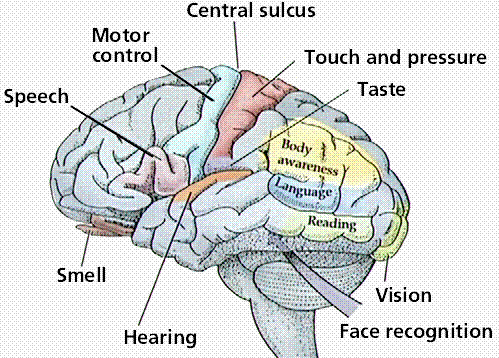
A brain.

In a way this is not dissimilar to that old chestnut supervisors often give their supervisees before heading to their first big conference – make sure if someone asks what you do that you are able to describe your research in a sentence. Although this flattening of nuance can seem a little counter-intuitive, it is necessary. Without telling people the basics first they are not going to get the nuance.

So I implore you, if you have yet to give a talk at a local club, heritage institution, or gallery then go and do it. I promise you’ll get something out of it. And if not at the very least you’ll be bought a drink, dinner, or – if you are lucky – both for your troubles.