
A short post this week the purpose of which is to share some more outputs from my project to map businesses auxiliary to the Georgian satirical print trade.
Below are two visualisations generated from the 1794 Kent’s London Directory and the 1808 London Post Office Directory. This time I’ve used a MapQuest script in Google Docs to geocode the address data (excellent tutorial here), cross-referenced the geocoding against Get Lat Lon and Locating London’s Past (which was necessary because – among other things – MapQuest was incapable of finding the Strand and Fleet Street), exported it all as a .geojson, and plugged the data into TileMill.
If you enjoy mapping data and haven’t used TileMill, I’d recommend spending an afternoon with it. Because if you are not interested in satellite imagery, TileMill is far more flexible and intuitive than Google Earth Pro, allowing you – for example – to add CSS styling to your data. In the images below I have ‘faked’ the heatmaps by simply turning down the opacity of each marker point using CSS. The results are interesting, first in teasing out the splintering of the east-west axis between 1794 and 1808, and second with regards to the increased use of the title ‘engraver’.

Colourmen: Yellow — Copper trade: Orange
Engravers: Grey — Paper Trade: White
Stationers: Blue — Printsellers: Red
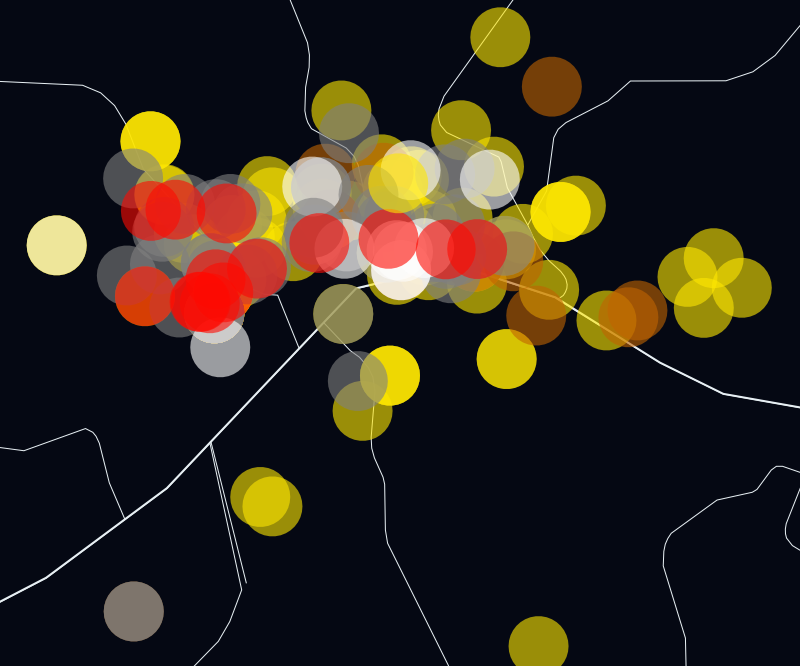
Colourmen: Yellow — Copper trade: Orange
Engravers: Grey — Paper Trade: White
Stationers: Blue — Printsellers: Red
Above all else it feels somehow liberating to be free to having plot on top of ‘real’ London and concentrate instead on the patterns the data generated. I have plenty of thoughts on this data which I will save for a later post (probably after I’ve given a research paper on October 24th based – among other things – on this data), but in the meantime if anyone is interested in an idiots guide to TileMill I’ll happily write one up for next week.
EDIT: Just a note to say that I’ve turned off the ‘Stationers’ in the above visualisations because their sheer volume crowds out everything else. I will definitely come back to them in more depth in a later post.
 cradledincaricature
You must be logged in to post a comment.