
I know a fair amount about crowds in history. Like many historians of Britain in the long-eighteenth century I was schooled on Rudé and Thompson. I learnt that calling a crowd a mob was a political act designed to flatten the complexities of a crowd. Instead, Rudé and Thompson suggested, crowds contained a multiplicity of actions and motivations.
This weekend I encountered a number of crowds. Two in particular made me think about the ability of historians to recover the inner workings of a crowd.
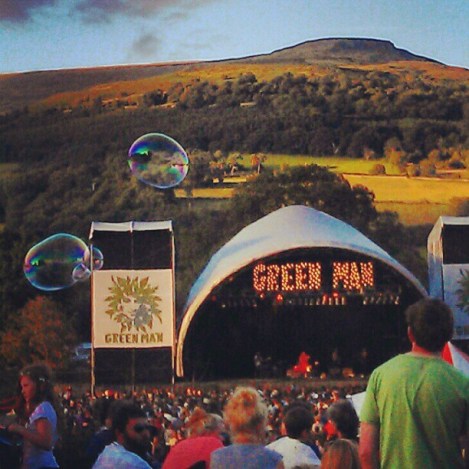
The first crowd was that which watched The Tallest Man on Earth perform the Saturday evening Far Out stage headline slot at the Green Man Festival. I was part of this crowd, having joined it around 30 minutes before Kristian Matsson was due to start. 4 or 5 rows of people were between me and the stage, most of whom were female, aged 16-25, and below 5 feet 6 inches in height. Among them was a smattering of ‘other’ festival goers – a small group of men in their 40s, a father with a child on his shoulders, and a couple of pre-teen boys leaning expectantly against the rail. Behind me the crowd began to swell, with people taking up positions close to those around them, and taking care (it seemed) not to unnecessarily obstruct the view of others. Then, with 5 minutes or so to go before the performance, a rush of young people – aged around 16-22 – began to squeeze their way to the front, pushing and obstructing those – like myself – who had waited patiently. Despite their eagerness to see the performance up-close, many of these newcomers spent much of the performance talking and texting, rather than observing and participating. Suddenly the moral economy of the crowd had – it seemed – broken down. The standards and behaviours that had dictated the flow of the festival to this point, were undermined by an overwhelming enthusiasm for one artist. As a participant in this crowd, the complexities of this dynamic – and the unrecorded and unrecordable gestural responses it provoked – were striking. How would this crowd be recorded I wondered? How could this crowd be recorded? Was my experience of ‘this crowd’ typical? And what implications might these thoughts have on how I read the reportage on crowds in history more generally?
The second memorable crowd I encountered this weekend was a rather different beast. In Fit the First of The Primary Phase of Douglas Adams’ marvellous The Hitchhiker’s Guide to the Galaxy radio series, Lady Cynthia Fitzmelton gives a speech before the people of Cottington. The occasion is to mark the destruction of the village to make way for a bypass. Cottington is, in Fitzmelton’s patronising words, “to be reborn as the very splendid and worthwhile Cottington Service Station”. The villagers are furious, jeering and heckling the speaker as she goes through the obligatory ceremonial niceties. Adams’ point is thus: authority has no respect, only power, for the power authority exhibits is prosthetic, plastic, false; and the crowd, though in possession of what could be seen as genuine power – consensus legitimised by wit and sarcasm – in fact have no power at all. Life then, as HGTG goes on to repeat at length, is defined by power vacuums with only the incapable willing to attempt filling these voids… I listened to this episode – for the umpteenth time – whilst dozing in my tent after the aforementioned performance by The Tallest Man on Earth. Once again the selective record of crowds came to mind. How easy would it be for a reporter to use language which suggested the crowd before Fitzmelton were in support of the work her ceremony was marking the beginning of? How do jeers and heckles make their way into the historical record? Or do they only do so when they appear in the form of large friendly letters?

I probably shouldn’t have been reflecting on the complexities of the historic crowd whilst on holiday. But the fact is that I did. It is after all our experiences – as much as what we read – which shape the questions we ask ourselves as historians. This weekend I was reminded not to flatten – not to homogenise – the crowd, and in turn the everyday lives and experiences of past people. Not bad for a muddy weekend in Wales.
 cradledincaricature
You must be logged in to post a comment.