All posts by jwbaker

James Baker is Director of Digital Humanities at the University of Southampton. James is a Software Sustainability Institute Fellow, a Fellow of the Royal Historical Society, and holds degrees from the University of Southampton and latterly the University of Kent, where in 2010 he completed his doctoral research on the late-Georgian artist-engraver Isaac Cruikshank. James works at the intersection of history, cultural heritage, and digital technologies. He is currently working on a history of knowledge organisation in twentieth century Britain. In 2021, I begin a major new Arts and Humanities Research Council funded project 'Beyond Notability: Re-evaluating Women’s Work in Archaeology, History and Heritage, 1870 – 1950'. Previous externally funded research projects have focused on legacy descriptions of art objects ('Legacies of Catalogue Descriptions and Curatorial Voice: Opportunities for Digital Scholarship', Arts and Humanities Research Council), the preservation of intangible cultural heritage ('Coptic Culture Conservation Collective', British Council, and 'Heritage Repertoires for inclusive and sustainable development', British Academy), the born digital archival record ('Digital Forensics in the Historical Humanities', European Commission), and decolonial futures for museum collections ('Making African Connections: Decolonial Futures for Colonial Collections', Arts and Humanities Research Council). Prior to joining Southampton, James held positions of Senior Lecturer in Digital History and Archives at the University of Sussex and Director of the Sussex Humanities Lab, Digital Curator at the British Library, and Postdoctoral Fellow with the Paul Mellon Centre for Studies in British Art. He is a member of the Arts and Humanities Research Council Peer Review College, a convenor of the Institute of Historical Research Digital History seminar, a member of The Programming Historian Editorial Board and a Director of ProgHist Ltd (Company Number 12192946), and an International Advisory Board Member of British Art Studies.

Week 19: Social Media in Learning

If I feel as though I’m saying ‘social media’ rather often these days, that is because I am. Today I spoke as part of the induction for the MA in Advanced Child Protection run by Kent’s Centre for Child Protection. The module is offered as a distance learning programme and the majority of the students enrolled are mature students, so – without wishing to imply that those outside of their 20s run away scared at the words ‘social’ and ‘media’ combined – an introduction to social media was required.

Hopefully not the notes they took.
Hopefully not the notes they took…

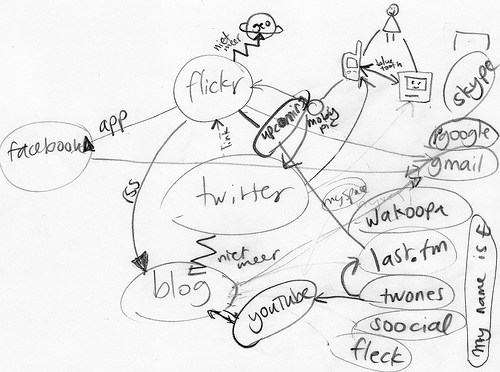
My slides can be seen/remixed/commented on here. Apart from going over the basics, I was keen to push the collaborative potential of social media for learning, that users should not be cautious, should not think in terms of there being set rules (apart form the legal ones, of course), and to think about if  – before how – social media can help them during their MAs (though at the same time sewing the seeds of ‘well of course it will you just don’t realise it yet…’). Talking afterwards to a colleague, he was struck by my insistence on not projecting: that, and this may seem quite obvious, if we all merely projected on Twitter et al the ‘social’ in social media would not exist. That he was struck by this – and hadn’t heard anyone else presenting on social media mention it – concerned me a little, but also reaffirmed that sometimes we all need to remember to talk about the basics. As with the undergraduates who insist on starting their essays on the French Revolution with the ODNB definitions of ‘revolution’, so we must spend some time talking about why the ‘social’ in social media is so important.