November is #AcWriMo. If you don’t know what #AcWriMo is – or indeed know nothing of its history – I recommend you head over to Anne Tarrant‘s excellent piece about it on Guardian Higher Ed. The basic jist of #AcWriMo – for those who are still here – is to create a community of academics (of whatever ilk) who guilt each other (that probably should be ‘support each other’) into writing-up their research. As everyone associated with academia knows, writing tends to be the most dramatic, painful, and procrastination inducing part of the process (we’ve all walked into gleaming apartments of colleagues who are clearly willing to do anything to avoid the writing that needs doing…). #AcWriMo seeks to undercut all the personal theatrics of academic writing by compelling participants to write using six simple rules:
- Decide on a goal that’s word, time or task based (and stretches you)
- Publicly declare said goal (this gives you a push from the start)
- Draft a strategy (planning in advance will focus you)
- Openly discuss your problems and progress
- Don’t slack off
- Declare your results at the end
With that in mind, I now declare – a day late I admit – that I will spend November doing the following:
- I will write between 500 and 1500 words on at least 20 days this November.
- My goal is to complete two of the six chapters planned to make up my book. These chapters are called ‘Bringing Cruikshank to Market’ and ‘The Market for Cruikshank’s’.
- These chapters will be based on my doctoral thesis, but will significantly divert from this to include research conducted during the first two months of my Paul Mellon Postdoc Fellowship and feedback from a recent research paper. I will write the chapters in order, and in order to focus my attention on this goal I spent the first day of #AcWriMo going through my Zotero notes and assigning against each proposed chapter.
- I will openly discuss my problems via @j_w_baker. I anticipate progress will be hampered by the fact I am giving four talks and opening an exhibition this month, though with regards to the latter there is significant cross-over with the chapters I am writing.
- I promise!
- I shall!
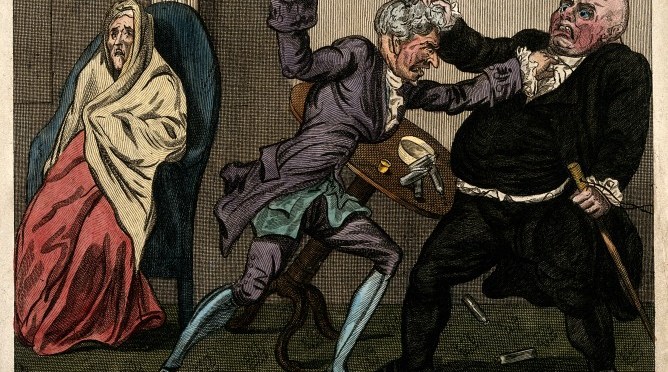
I am confident this is an ambitious target and – without sounds defeatist already – one I may not achieve. That said I do get to talk about satires such as the one below in my work, so I shouldn’t complain too much… See you all at #AcWriMo!

Credit: Wellcome Library, London
Copyrighted work available under Creative Commons by-nc 2.0 UK: England & Wales, see http://images.wellcome.ac.uk/indexplus/page/Prices.html
 cradledincaricature
You must be logged in to post a comment.