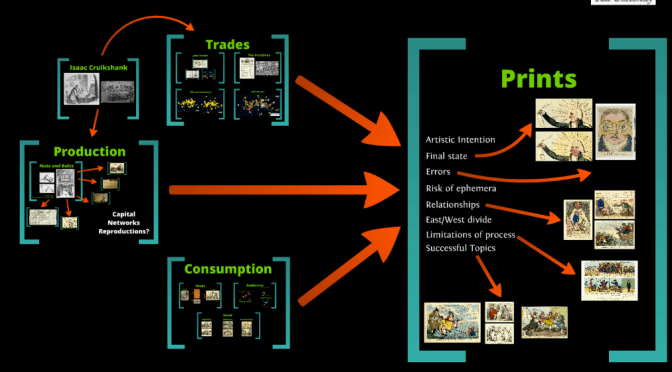
Last night I had the pleasure of speaking as part of the research seminar series at the School of History, University of Kent. My talk – entitled The Money Behind the Funny: business networks and satirical printing in late-Georgian London – brought together eight weeks of focused research funded by the Paul Mellon Centre for Studies in British Art. Focusing on the satirical work of Isaac Cruikshank, I argued that a wide-angled perspective on satirical printing, a perspective which does not privilege artist intention and meaning but instead asks how far the process of making satirical prints shaped and constrained the satires that made their way into the late-Georgian metropolis, enriches our reading of Georgian satire.
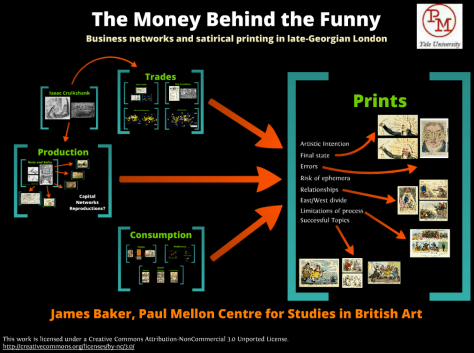
I’m not going to post a transcript of the talk here as it will form the basis of a chapter from my forthcoming book, however audio and slides from the talk are available above. Instead, I’m going to use this opportunity to reflect on some the questions that were asked:
If Humphrey’s shop is not the model print shop window, what did the shop fronts of the businesses you describe look like? And how did they display their wares?
Quite simply, print shop windows were more diverse than we tend to imagine, primarily because – as my talk outlined – most ‘printshops’ sold a diversity of wares. Fores‘ shop window seems to have changed between the 1790s and 1810, from a Humphrey-esque space to one more akin to a stationers. An elderly Jemmy Whittle is described by William Hone as being concerned to ensure his shop front was bright and appealing, with panes decorated with twelve prints depicted the flowers of each month. When windows did focus on prints, it seems – though this is hard to ascertain – that portraits would dominate the extremities of the window with new prints on new subjects occupying the centre ground. It is tempting to suggest that it was this centre ground which was subject to most change, but evidence for this is lacking.
Thinking back to the pro-Williamite satires of Romeyn de Hooghe which were made with remarkable speed but without the errors your paper shows litter the Isaac Cruikshank corpus, how can these errors be explained? How did the situation arise that made these errors so acceptable to print customers?
I suspect that in Isaac’s case, errors – especially corrections to spelling mistakes – were acceptable to him because he purchased the copper plates he engraved/etched on. His publishers – especially Samuel Fores in the 1790s – were perhaps happy to accept substandard work as Cruikshank’s less elaborate style ensured he could either get ephemeral prints to market quicker than James Gillray, or rapidly respond to an effective and commercially successful Gillray motif. Certainly Isaac’s social mezzotints for Laurie & Whittle do not contain these sorts of errors. Telling a story of the change in print quality from the early to late eighteenth century is something I plan to put some more research into. But at this stage I’m not totally sure why publishers such as Fores were so accepting of, for example, spelling errors and corrections in the 1790s. What is clear is that by 1805 Fores is much more demanding and discerning, that the quality of his plates and colouring improves, and as a consequence Isaac starts working more closely with other perhaps less discerning publishers.
You’ve described satirical prints as part of a luxury trade, not dissimilar to silks or jewelry, but I wonder whether you could say something about investment into the trade from private individuals?
This I know very little on. Samuel Fores had a sometime business partner called Benjamin Mitchell, which we know because they filed a joint insurance policy with the Sun Fire Office on 9 February 1810 for a warehouse at 21 Marylebone Street. Around the same time we know that Rudolph Ackermann was looking for a business partner, though, as I made clear in the talk, his business was far larger and broader than Fores’. Beyond that, the trade seemingly worked on a master-apprentice dynamic. That said, the rise of the book and print publisher Thomas Tegg around 1805 is telling, for he seemed to pioneer a new model of business which undercut his competition and ruthlessly took advantage of lax copyright laws. The apparent disdain his actions elicited suggests he was thought of as different from the old guard of print publishers, so perhaps there is some class snobbery going on here. Either way, this area needs more research.
What can you tell us about definitive business connections within the geographical network of auxiliary trades you have described? And how similar or different is this network to those in other urban areas, such as Manchester or Edinburgh?
Comparing the networks of printers, publishers, oil and colourmen, paper merchants et al in London with those in other urban spaces is something I would like to do in the future, but have yet to. With regards to definitive business links between different trades in this network, the nearest we come is through printers of catalogues and books for printsellers. I certainly plan to do some more work on this over the coming months.
 cradledincaricature
You must be logged in to post a comment.