All posts by jwbaker

James Baker is Director of Digital Humanities at the University of Southampton. James is a Software Sustainability Institute Fellow, a Fellow of the Royal Historical Society, and holds degrees from the University of Southampton and latterly the University of Kent, where in 2010 he completed his doctoral research on the late-Georgian artist-engraver Isaac Cruikshank. James works at the intersection of history, cultural heritage, and digital technologies. He is currently working on a history of knowledge organisation in twentieth century Britain. In 2021, I begin a major new Arts and Humanities Research Council funded project 'Beyond Notability: Re-evaluating Women’s Work in Archaeology, History and Heritage, 1870 – 1950'. Previous externally funded research projects have focused on legacy descriptions of art objects ('Legacies of Catalogue Descriptions and Curatorial Voice: Opportunities for Digital Scholarship', Arts and Humanities Research Council), the preservation of intangible cultural heritage ('Coptic Culture Conservation Collective', British Council, and 'Heritage Repertoires for inclusive and sustainable development', British Academy), the born digital archival record ('Digital Forensics in the Historical Humanities', European Commission), and decolonial futures for museum collections ('Making African Connections: Decolonial Futures for Colonial Collections', Arts and Humanities Research Council). Prior to joining Southampton, James held positions of Senior Lecturer in Digital History and Archives at the University of Sussex and Director of the Sussex Humanities Lab, Digital Curator at the British Library, and Postdoctoral Fellow with the Paul Mellon Centre for Studies in British Art. He is a member of the Arts and Humanities Research Council Peer Review College, a convenor of the Institute of Historical Research Digital History seminar, a member of The Programming Historian Editorial Board and a Director of ProgHist Ltd (Company Number 12192946), and an International Advisory Board Member of British Art Studies.

Google network graphs

Recently I decided to plug a .csv file I’ve been using with ArcGIS into Google Fusion Tables. The file is a test dataset containing, among other things, information on where prints by Isaac Cruikshank were published and where these prints depict (both specifically and generally). Although far from complete, it has got me thinking about the relationship between place and publication, and the yearly trends evident in the Cruikshank corpus.

Anyhow, I plugged this into a fusion tables so I could play with another geospatial tool, but in the end I just started messing around with network graphs. And I’m not the only person who has been doing this recently (nor it seems the only person who has no idea what this means).

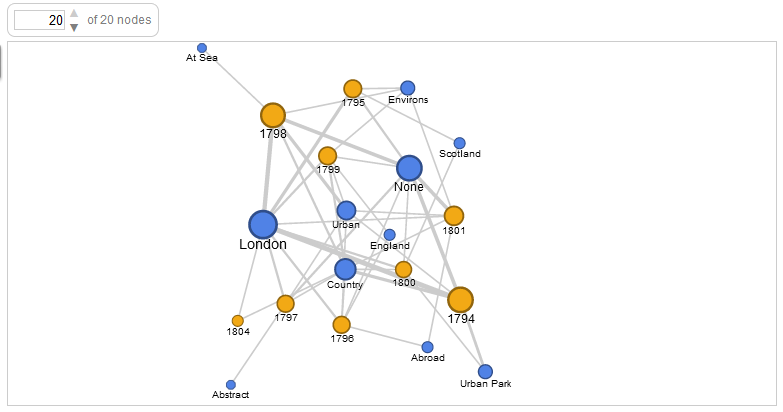
I’ve included some visualisations of data derived from Isaac Cruikshank prints below. The first plots publishers against year. The second plots publishers against general place depicted. The third plots general place depicted against year, for prints published by Laurie & Whittle. And the fourth plots general place depicted against year, for prints published by Samuel Fores.

Although the dataset is far from complete (containing only 171 of circa 1000 prints) there are signs of patterns emerging from the network grphs (many of which I expected). Though I expect that traditional graphs and tables could do just the same… I’ll continue playing and report back if the visualizations produce anything of note.

Publisher plotted against year
Publisher plotted against general place depicted
General place depicted plotted against year (for Laurie & Whittle publications)
General place depicted plotted against year (for Samuel Fores publications)